
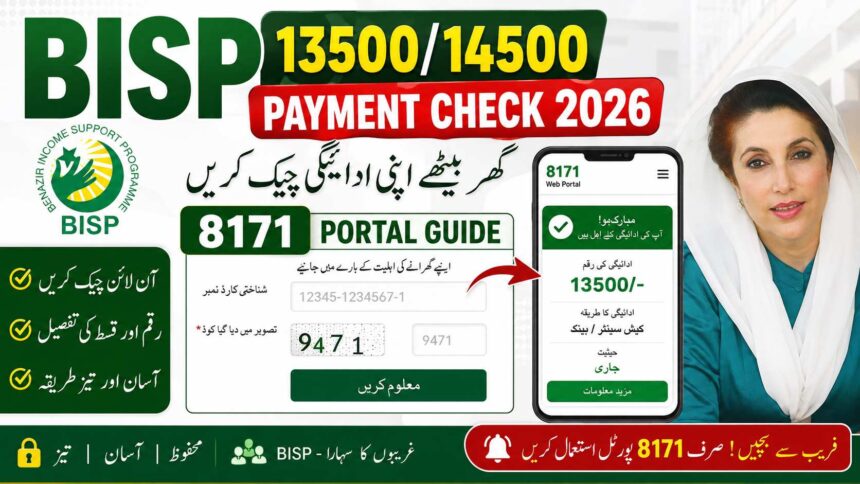
BISP 13500 / 14500 Payment Check: How to See Your Status Online in 2 Minutes
If you’ve been typing “BISP 13500 check” into Google every few days waiting for your qist to show up, you’re not alone. Millions of women across Pakistan do exactly the same thing every quarter refreshing the 8171 portal, asking a neighbour who already got their payment, or standing in a bank queue just to be told “abhi nahi aaya.”
The good news is that checking your BISP payment status has actually gotten easier over the last year. The bad news is that the amount keeps changing, which means half the “guides” floating around on Google are outdated the moment you read them. So let’s clear that up first, then walk through the actual check.
Is It Rs. 13,500 or Rs. 14,500 Right Now?
Here’s where a lot of the confusion comes from.
Rs. 13,500 was the quarterly Kafaalat payment through most of 2025 and into early 2026. Then, starting with the Ramadan 2026 cycle, BISP Chairperson Senator Rubina Khalid announced an increase to Rs. 14,500 per quarter and that’s the figure currently being paid for the July–September 2026 cycle.
So if a website is still telling you the payment is Rs. 13,500, that’s old information. If someone tells you it’s already Rs. 18,000, that’s also not accurate yet that figure was confirmed in the FY2026-27 federal budget but is scheduled to start from January 2027, not now.
For this quarter (July–September 2026), the correct number to check against is Rs. 14,500.
What You Need Before You Check
Nothing complicated. Just:
- Your 13-digit CNIC number, entered without dashes (so
3520212345678, not35202-1234567-8) - A working internet connection even a basic mobile data connection is fine
- Two minutes of patience, because the captcha sometimes needs a retry
One thing beneficiaries often get wrong: the CNIC used has to be the registered female head of household’s CNIC — not her husband’s, not her son’s. If you enter a family member’s CNIC by mistake, the portal will simply show nothing, and people assume they’ve been removed from the program when actually they just checked the wrong number.
Step-by-Step: Checking on the 8171 Portal
- Go to the official portal type
8171.bisp.gov.pkdirectly into your browser’s address bar. Don’t tap a link shared on WhatsApp or Facebook, even if it looks identical. Fake copies of this portal exist specifically to collect people’s CNIC data. - Enter your CNIC in the box provided, no dashes, no spaces.
- Type the captcha code exactly as shown. This step trips people up the most — zero (0) and the letter O look almost identical on some phone screens, so look carefully before submitting.
- Press “Maloom Karein” (or “Submit” if the page is showing in English).
- Read your result. You’ll typically see one of these:
- Payment Released — your Rs. 14,500 is available for collection this cycle
- In Process — you’re approved, but your district’s payment phase hasn’t opened yet
- Eligible — you’re in the system and approved, payment scheduled but not released
- Ineligible — something in your record needs attention (see below)
Checking Without Internet: The SMS Method
Not everyone has smooth internet access, especially in smaller towns and rural areas. If that’s you, there’s a simpler backup:
Send your CNIC number (again, no dashes) as a text message to 8171. You’ll get a reply within a few minutes showing your current status. It works on basic phones too, not just smartphones, and there’s no charge for the service.
“It Says Ineligible” — What Actually Causes This
This is probably the most stressful result to see, and honestly, most of the time it isn’t as final as it sounds. Common reasons include:
- Your NSER survey data hasn’t been updated recently (BISP re-verifies household income data periodically)
- A mismatch between your CNIC details and NADRA’s records maybe your CNIC was recently renewed and the systems haven’t synced yet
- Your household income bracket shifted during the last dynamic survey
If you see “Ineligible,” the fastest fix isn’t to keep refreshing the portal it’s to visit your nearest BISP Tehsil office in person with your original CNIC. They can usually tell you exactly which of the above applied to your case within the same visit.
A Word on Scam Websites
This is worth taking seriously. Because BISP-related searches get so much traffic, a whole ecosystem of copycat sites has grown around it some just running ads, others actively trying to collect your CNIC and phone number under the pretense of “processing your payment faster.”
A simple rule protects you from almost all of it: the only official portal is 8171.bisp.gov.pk. No legitimate BISP communication will ever ask you to pay a “processing fee” to release your installment, and no genuine agent will deduct money from your payment before handing it over. If a bank agent or device gives you less than Rs. 14,500 this cycle, that’s a red flag worth reporting at your nearest BISP office.
Quick Recap
- Current quarterly payment: Rs. 14,500 (July–September 2026 cycle)
- Check online:
8171.bisp.gov.pk, enter CNIC without dashes - No internet? Send your CNIC via SMS to 8171
- “Ineligible” result usually means an NSER or NADRA data mismatch — visit your Tehsil office
- Never trust a portal you reached through a WhatsApp or Facebook link
If your payment still hasn’t shown up despite an “Eligible” status, that generally means your district’s disbursement phase simply hasn’t started yet BISP releases payments phase-wise across the country rather than nationwide on a single day, so a short wait is normal before you need to worry.
This article is for informational purposes and reflects publicly available BISP updates as of August 2026. For your specific case, always confirm through the official 8171 portal or your nearest BISP Tehsil office.